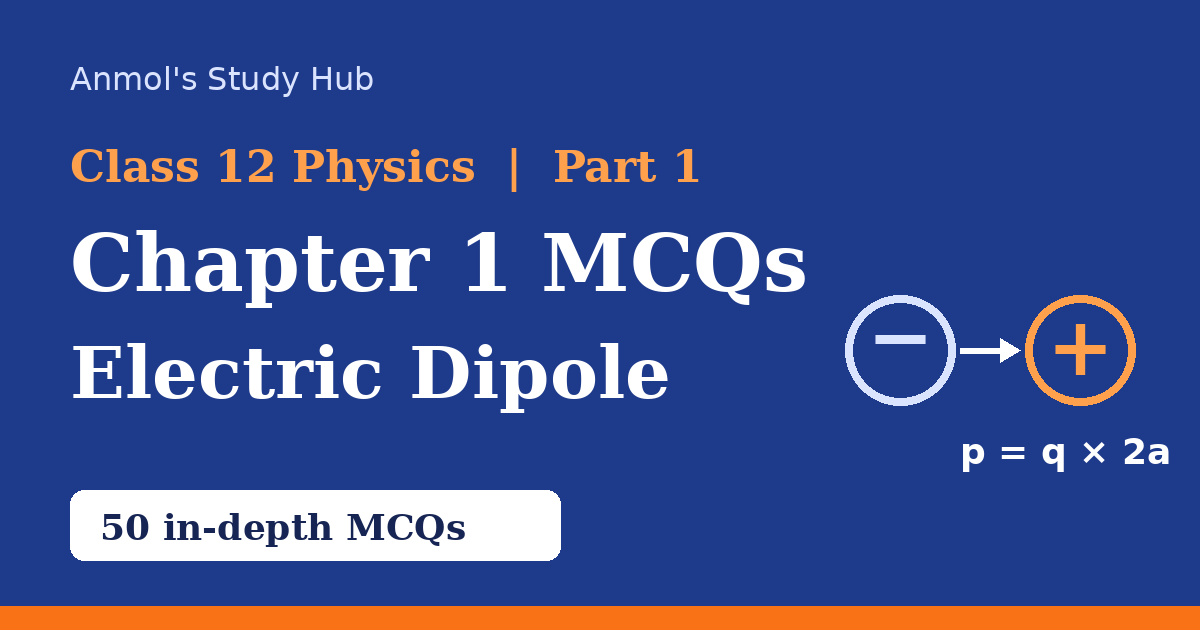
Class 12 Physics Part 1, Chapter 1 MCQs: Electric Dipole
Electric Charges and Fields, Topic 4 of 6 · 50 in-depth MCQs · Name-based score card
Topic in one minute
This topic is about the electric dipole, a pair of equal and opposite charges a small distance apart. It covers the dipole moment and its unit, the field of a dipole on the axial and equatorial lines, and what a uniform electric field does to a dipole: zero net force, but a torque that turns it to line up with the field.
Question levels
| Level | What it covers | MCQs |
|---|---|---|
| Concept questions | Definition and unit of dipole moment, axial and equatorial fields, torque, equilibrium positions | 20 |
| Numerical problems | Dipole moment, axial and equatorial field values, torque at different angles, effect of changing distance | 18 |
| Application and reasoning | Polar and non-polar molecules, non-uniform fields, oscillation, equilibrium, far-field behaviour | 12 |
Practise the MCQs
Choose a mode and start answering. No sign-up is needed. Your name is optional and is asked only when you press Show my score card.
1. An electric dipole is a pair of:
Show answer and explanation
Answer: B. Equal and opposite charges separated by a small distance. A dipole has charges +q and −q a small distance 2a apart.
2. The magnitude of the dipole moment is:
Show answer and explanation
Answer: B. q × 2a. p = q × 2a, the charge times the separation.
3. The SI unit of dipole moment is:
Show answer and explanation
Answer: C. C m. Charge times distance gives coulomb metre (C m).
4. The dipole moment vector points from:
Show answer and explanation
Answer: B. The negative to the positive charge. By convention, p points from −q to +q.
5. The dipole moment is a:
Show answer and explanation
Answer: B. Vector. It has both magnitude and direction.
6. The axial line of a dipole is the line:
Show answer and explanation
Answer: B. Passing through both charges. It is the line joining the two charges, extended on both sides.
7. The equatorial line of a dipole is the line:
Show answer and explanation
Answer: B. Perpendicular bisector of the line joining the charges. It passes through the midpoint and is perpendicular to the axis.
8. The electric field at a point on the axial line is directed:
Show answer and explanation
Answer: B. Along p. On the axial line, the field points in the direction of the dipole moment.
9. The electric field at a point on the equatorial line is directed:
Show answer and explanation
Answer: B. Opposite to p. There, the field is antiparallel to the dipole moment.
10. For a short dipole at a large distance r, the axial field is:
Show answer and explanation
Answer: B. 2kp/r³. E(axial) ≈ 2kp/r³.
11. For a short dipole at a large distance r, the equatorial field is:
Show answer and explanation
Answer: B. kp/r³. E(equatorial) ≈ kp/r³, half the axial value.
12. The field of a dipole at large distances falls off as:
Show answer and explanation
Answer: C. 1/r³. This is faster than the 1/r² of a single charge.
13. The net charge of an electric dipole is:
Show answer and explanation
Answer: C. Zero. +q and −q add to zero.
14. The net force on a dipole in a uniform electric field is:
Show answer and explanation
Answer: B. Zero. The forces on the two charges are equal and opposite.
15. The torque on a dipole in a uniform field has magnitude:
Show answer and explanation
Answer: B. pE sin θ. τ = p × E, so τ = pE sin θ.
16. The torque on a dipole in a uniform field is zero when the angle between p and E is:
Show answer and explanation
Answer: C. 0° or 180°. sin θ = 0 for θ = 0° or 180°.
17. The torque is maximum when the angle between p and E is:
Show answer and explanation
Answer: B. 90°. sin θ is largest at 90°, giving τ = pE.
18. The stable equilibrium position of a dipole in a uniform field is when p is:
Show answer and explanation
Answer: A. Parallel to E. At θ = 0° the dipole returns to this position if slightly disturbed.
19. The unstable equilibrium position of a dipole in a uniform field is when p is:
Show answer and explanation
Answer: B. Antiparallel to E. At θ = 180°, a small disturbance makes it swing away.
20. A dipole in a uniform electric field tends to:
Show answer and explanation
Answer: B. Align itself with the field. The torque rotates p towards E.
21. Charges of ±5 nC are 4 cm apart. The dipole moment is:
Show answer and explanation
Answer: A. 2 × 10⁻¹⁰ C m. p = 5×10⁻⁹ × 0.04 = 2 × 10⁻¹⁰ C m.
22. A dipole of moment 3 × 10⁻⁸ C m is at 90° to a field of 2 × 10⁴ N/C. The torque is:
Show answer and explanation
Answer: A. 6 × 10⁻⁴ N m. τ = pE sin 90° = 3×10⁻⁸ × 2×10⁴ = 6 × 10⁻⁴ N m.
23. A dipole of moment 4 × 10⁻⁹ C m makes 30° with a field of 5 × 10⁴ N/C. The torque is:
Show answer and explanation
Answer: A. 1 × 10⁻⁴ N m. τ = 4×10⁻⁹ × 5×10⁴ × 0.5 = 1 × 10⁻⁴ N m.
24. The maximum torque on a dipole of moment 2 × 10⁻⁸ C m in a field of 10³ N/C is:
Show answer and explanation
Answer: A. 2 × 10⁻⁵ N m. τ(max) = pE = 2×10⁻⁸ × 10³ = 2 × 10⁻⁵ N m.
25. A short dipole of moment 3 × 10⁻⁹ C m has an axial field at r = 0.3 m of about:
Show answer and explanation
Answer: A. 2 × 10³ N/C. E = 2kp/r³ = 2 × 9×10⁹ × 3×10⁻⁹ / 0.027 = 2 × 10³ N/C.
26. For the same dipole at r = 0.3 m, the equatorial field is about:
Show answer and explanation
Answer: A. 10³ N/C. E = kp/r³ = 9×10⁹ × 3×10⁻⁹ / 0.027 = 10³ N/C.
27. The axial field of a short dipole is 800 N/C at a distance r. At 2r, it is:
Show answer and explanation
Answer: C. 100 N/C. E is proportional to 1/r³, so doubling r gives 800/8 = 100 N/C.
28. The field of a short dipole is 270 N/C at a distance r. At 3r, it is:
Show answer and explanation
Answer: A. 10 N/C. Tripling r divides E by 27, so E = 10 N/C.
29. The ratio of the axial to the equatorial field at the same large distance is:
Show answer and explanation
Answer: B. 2 : 1. E(axial)/E(equatorial) = 2kp/r³ ÷ kp/r³ = 2.
30. The dipole moment of a dipole is doubled, with the distance unchanged. The far field:
Show answer and explanation
Answer: B. Doubles. The field is proportional to p.
31. Both the charge and the separation of a dipole are doubled. The dipole moment becomes:
Show answer and explanation
Answer: B. Four times. p = q × 2a, so 2 × 2 = 4 times.
32. Charges ±1.6 × 10⁻¹⁹ C are 10⁻¹⁰ m apart. The dipole moment is:
Show answer and explanation
Answer: A. 1.6 × 10⁻²⁹ C m. p = 1.6×10⁻¹⁹ × 10⁻¹⁰ = 1.6 × 10⁻²⁹ C m.
33. A dipole of moment 10⁻⁶ C m feels a maximum torque of 5 × 10⁻³ N m. The field is:
Show answer and explanation
Answer: A. 5 × 10³ N/C. E = τ/p = 5×10⁻³ / 10⁻⁶ = 5 × 10³ N/C.
34. At θ = 30°, the torque on a dipole is what fraction of its maximum value?
Show answer and explanation
Answer: A. 1/2. sin 30° = 1/2.
35. At θ = 60°, the torque on a dipole is what fraction of its maximum value?
Show answer and explanation
Answer: B. √3/2. sin 60° = √3/2.
36. The net force on a dipole in a uniform field of 10⁴ N/C is:
Show answer and explanation
Answer: A. Zero. Equal and opposite forces on the two charges cancel.
37. Charges of ±3 µC are 2 mm apart. The dipole moment is:
Show answer and explanation
Answer: A. 6 × 10⁻⁹ C m. p = 3×10⁻⁶ × 2×10⁻³ = 6 × 10⁻⁹ C m.
38. A dipole of moment 10⁻⁸ C m is parallel (θ = 0°) to a field of 10⁴ N/C. The torque is:
Show answer and explanation
Answer: A. Zero. τ = pE sin 0° = 0.
39. A dipole placed in a non-uniform electric field experiences:
Show answer and explanation
Answer: B. A net force and a torque. The forces on the two charges differ, so there is a net force as well as a torque.
40. In a uniform field, a dipole shows:
Show answer and explanation
Answer: A. Only rotation, with no translation. The net force is zero, but the torque turns it.
41. A water molecule is a polar molecule because its:
Show answer and explanation
Answer: B. Centres of positive and negative charge do not coincide. The bent shape gives it a permanent dipole moment.
42. A CO₂ molecule has no permanent dipole moment because:
Show answer and explanation
Answer: B. Its linear, symmetric shape makes the bond dipoles cancel. The two equal and opposite bond dipoles add to zero.
43. A dipole is released from rest at 90° to a uniform field. It will:
Show answer and explanation
Answer: B. Oscillate about the direction of the field. The torque pulls it towards θ = 0°, and it swings past and back.
44. At large distances, the dipole field is weaker than the field of a single charge because:
Show answer and explanation
Answer: B. The fields of +q and −q partly cancel. The two fields nearly cancel, leaving a field that falls as 1/r³.
45. The far field of a small dipole depends on q and the separation 2a only through:
Show answer and explanation
Answer: B. Their product p. The field depends on the dipole moment p = q × 2a.
46. A dipole is released from rest at 30° to a uniform field. It will:
Show answer and explanation
Answer: A. Rotate to align p with E. The torque turns p towards the field, to the stable position θ = 0°.
47. The field lines of a dipole:
Show answer and explanation
Answer: B. Start on +q, end on −q, and are curved. They leave the positive charge and curve round to enter the negative charge.
48. A dipole has zero net charge, yet it produces an electric field because:
Show answer and explanation
Answer: B. The two charges are at different places. The fields of +q and −q cancel only partly, since the charges are separated.
49. When p is antiparallel to E (θ = 180°), the torque is:
Show answer and explanation
Answer: A. Zero, and the equilibrium is unstable. The torque is zero, but any small push makes it rotate away.
50. The torque on a dipole in a uniform field is directed:
Show answer and explanation
Answer: C. Perpendicular to the plane containing p and E. τ = p × E, which is perpendicular to both p and E.
Common mistakes in this topic
- Taking the distance between the charges as a instead of 2a. The dipole moment uses the full separation 2a.
- Pointing the dipole moment from + to −. It points from the negative charge to the positive charge.
- Mixing up the axial field (along p, twice as large) and the equatorial field (opposite to p).
- Forgetting that the net force on a dipole in a uniform field is zero, even though the torque is not.
Quick FAQ
How should I use these MCQs? Start with Practice mode to learn from each explanation, then switch to Test mode and attempt all 50 questions without help.
What is “Retry my mistakes”? After your score card, it shows only the questions you got wrong or skipped, so you can practise them again.