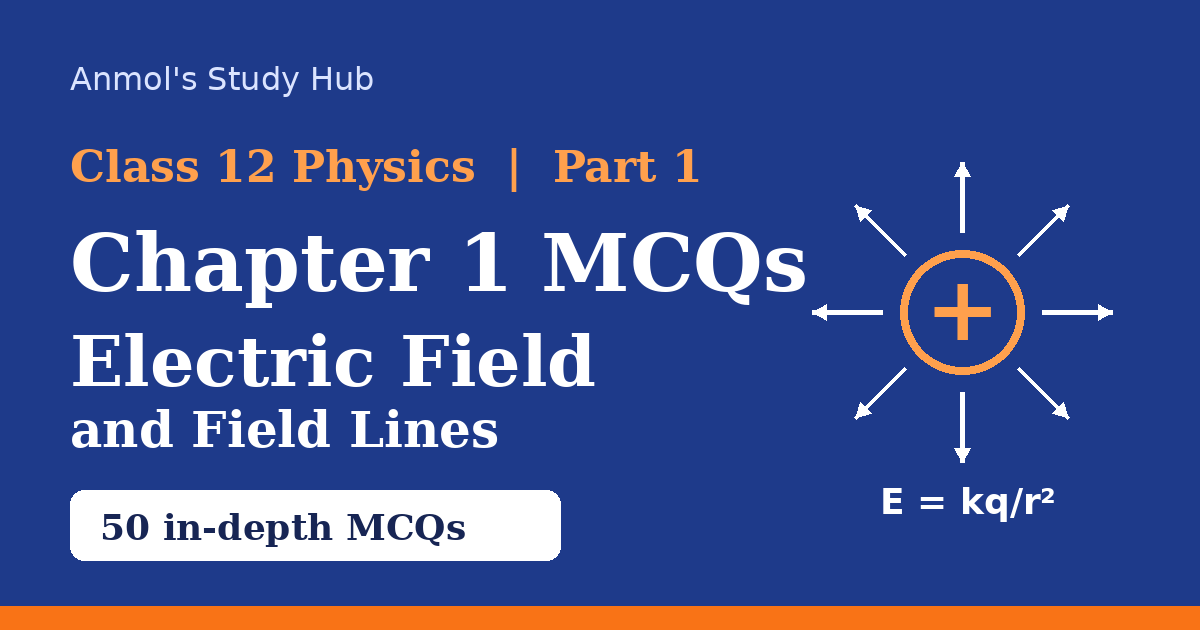
Class 12 Physics Part 1, Chapter 1 MCQs: Electric Field and Field Lines
Electric Charges and Fields, Topic 3 of 6 · 50 in-depth MCQs · Name-based score card
Topic in one minute
This topic explains how a charge affects the space around it. It covers the electric field and its unit, the field of a point charge, the field of several charges by superposition, the force and acceleration of a charge in a field, and the rules for drawing and reading electric field lines.
Question levels
| Level | What it covers | MCQs |
|---|---|---|
| Concept questions | Definition and unit of E, field of a point charge, superposition of fields, properties of field lines | 20 |
| Numerical problems | Field of a point charge, force and acceleration in a field, field at the midpoint, resultant fields, equilibrium of a charge | 18 |
| Application and reasoning | Direction of motion, field line diagrams, neutral points, uniform fields, test charges, graph of E against r | 12 |
Practise the MCQs
Choose a mode and start answering. No sign-up is needed. Your name is optional and is asked only when you press Show my score card.
1. The electric field at a point is the force per unit:
Show answer and explanation
Answer: B. Positive test charge. E = F/q, where q is a small positive test charge placed at the point.
2. The SI unit of electric field is:
Show answer and explanation
Answer: C. N/C. Force per unit charge gives newton per coulomb (N/C), which equals V/m.
3. The magnitude of the field of a point charge q at distance r is:
Show answer and explanation
Answer: B. kq/r². E = kq/r², from Coulomb’s law.
4. The field of a negative point charge is directed:
Show answer and explanation
Answer: B. Radially inward. The field points away from positive charges and toward negative charges.
5. The electric field is a:
Show answer and explanation
Answer: B. Vector. It has both magnitude and direction.
6. The test charge used to define the field should be:
Show answer and explanation
Answer: B. Very small. A small test charge avoids disturbing the source charges.
7. The field at a point due to several charges is the:
Show answer and explanation
Answer: B. Vector sum of the fields due to each charge. Fields obey the superposition principle and add as vectors.
8. Electric field lines start from:
Show answer and explanation
Answer: B. Positive charges and end on negative charges. By convention, lines begin on positive charges and end on negative charges.
9. The tangent to a field line at a point gives the:
Show answer and explanation
Answer: A. Direction of the field at that point. The tangent shows the direction of E at that point.
10. Where field lines are crowded together, the field is:
Show answer and explanation
Answer: B. Stronger. The density of lines represents the field strength.
11. Electric field lines near the surface of a conductor are:
Show answer and explanation
Answer: B. Perpendicular to the surface. In electrostatics, the field at a conductor’s surface is normal to it.
12. A uniform electric field is represented by lines that are:
Show answer and explanation
Answer: A. Parallel and equally spaced. Constant direction and strength give equally spaced parallel lines.
13. The field lines of a single positive point charge are:
Show answer and explanation
Answer: B. Radial lines pointing outward. They spread out symmetrically from the charge.
14. For two equal positive charges, the field at the midpoint of the line joining them is:
Show answer and explanation
Answer: B. Zero. The two fields are equal and opposite, so they cancel.
15. For charges +q and −q, the field at the midpoint is:
Show answer and explanation
Answer: B. Non-zero and directed from +q to −q. Both fields point the same way, from the positive to the negative charge, so they add.
16. A point where the net electric field is zero is called a:
Show answer and explanation
Answer: A. Neutral point. At a neutral point, the fields from all the charges cancel.
17. The force on a charge q in an electric field E is:
Show answer and explanation
Answer: C. F = qE. From the definition E = F/q.
18. The field of a point charge depends on distance as:
Show answer and explanation
Answer: B. 1/r². It follows an inverse-square law.
19. The force on a negative charge in an electric field is directed:
Show answer and explanation
Answer: B. Opposite to the field. F = qE, and q is negative, so F is opposite to E.
20. Electric field lines are:
Show answer and explanation
Answer: B. A way of representing the field. They are a visual tool and have no physical existence.
21. The field at 0.3 m from a 2 µC point charge is about:
Show answer and explanation
Answer: A. 2 × 10⁵ N/C. E = 9×10⁹ × 2×10⁻⁶ / (0.3)² = 2 × 10⁵ N/C.
22. The force on a 5 µC charge in a field of 2 × 10⁴ N/C is:
Show answer and explanation
Answer: D. 0.1 N. F = qE = 5×10⁻⁶ × 2×10⁴ = 0.1 N.
23. The force on an electron in a field of 10⁴ N/C is:
Show answer and explanation
Answer: A. 1.6 × 10⁻¹⁵ N. F = eE = 1.6×10⁻¹⁹ × 10⁴ = 1.6 × 10⁻¹⁵ N.
24. The field of a point charge is 80 N/C at a distance r. At a distance 2r, it is:
Show answer and explanation
Answer: C. 20 N/C. E is proportional to 1/r², so doubling r gives 80/4 = 20 N/C.
25. A charge of 4 µC experiences a force of 0.2 N. The electric field is:
Show answer and explanation
Answer: B. 5 × 10⁴ N/C. E = F/q = 0.2 / 4×10⁻⁶ = 5 × 10⁴ N/C.
26. The acceleration of an electron in a field of 10³ N/C is about:
Show answer and explanation
Answer: A. 1.8 × 10¹⁴ m/s². a = eE/m = 1.6×10⁻¹⁹ × 10³ / 9.1×10⁻³¹ ≈ 1.8 × 10¹⁴ m/s².
27. The acceleration of a proton in a field of 10³ N/C is about (m = 1.67 × 10⁻²⁷ kg):
Show answer and explanation
Answer: A. 9.6 × 10¹⁰ m/s². a = eE/m = 1.6×10⁻¹⁶ / 1.67×10⁻²⁷ ≈ 9.6 × 10¹⁰ m/s².
28. Charges +2 µC and −2 µC are 0.2 m apart. The field at the midpoint is:
Show answer and explanation
Answer: C. 3.6 × 10⁶ N/C. Each gives 9×10⁹ × 2×10⁻⁶ / (0.1)² = 1.8×10⁶ N/C in the same direction, so the total is 3.6 × 10⁶ N/C.
29. Two fields of 3 × 10⁴ N/C and 4 × 10⁴ N/C act at a point at right angles. The resultant field is:
Show answer and explanation
Answer: D. 5 × 10⁴ N/C. The resultant is √(3² + 4²) × 10⁴ = 5 × 10⁴ N/C.
30. The field at 3 cm from a 1 nC point charge is:
Show answer and explanation
Answer: B. 10⁴ N/C. E = 9×10⁹ × 10⁻⁹ / (0.03)² = 10⁴ N/C.
31. The field of a point charge is 400 N/C at a distance r. At a distance r/2, it is:
Show answer and explanation
Answer: C. 1600 N/C. Halving r multiplies E by 4, so E = 1600 N/C.
32. The point charge that produces a field of 9 × 10³ N/C at 1 m is:
Show answer and explanation
Answer: B. 1 µC. q = Er²/k = 9×10³ / 9×10⁹ = 10⁻⁶ C = 1 µC.
33. An electron starts from rest in a field of 500 N/C. After 10⁻⁸ s, its speed is about:
Show answer and explanation
Answer: C. 8.8 × 10⁵ m/s. a = eE/m ≈ 8.8 × 10¹³ m/s², so v = at ≈ 8.8 × 10⁵ m/s.
34. A field of 200 N/C acts on a charge of −3 µC. The force magnitude is:
Show answer and explanation
Answer: D. 6 × 10⁻⁴ N. F = qE = 3×10⁻⁶ × 200 = 6 × 10⁻⁴ N, opposite to the field.
35. Charges +q and −q are a distance d apart. The field at the midpoint is:
Show answer and explanation
Answer: D. 8kq/d². Each charge gives kq/(d/2)² = 4kq/d², and the two add to 8kq/d².
36. A charge of 10⁻⁸ C of mass 10⁻⁶ kg hangs in equilibrium in a vertical field (g = 10 m/s²). The field is:
Show answer and explanation
Answer: B. 10³ N/C. qE = mg gives E = 10⁻⁶ × 10 / 10⁻⁸ = 10³ N/C.
37. The field at 3 m from a 1 C point charge is:
Show answer and explanation
Answer: C. 10⁹ N/C. E = 9×10⁹ × 1 / 3² = 10⁹ N/C.
38. A particle of charge 2 µC and mass 10⁻⁶ kg is in a field of 500 N/C. Its acceleration is:
Show answer and explanation
Answer: B. 10³ m/s². a = qE/m = 2×10⁻⁶ × 500 / 10⁻⁶ = 10³ m/s².
39. A positive test charge at a point is pushed towards the east. The field there points:
Show answer and explanation
Answer: B. East. The field has the direction of the force on a positive test charge.
40. A positive charge is released from rest in a uniform field. It moves:
Show answer and explanation
Answer: B. Along the field in a straight line. The force qE is constant and along E, so it speeds up along the field.
41. An electron is released from rest in a uniform field pointing east. It moves:
Show answer and explanation
Answer: B. West. The force on a negative charge is opposite to the field.
42. For two equal and opposite charges, the field is zero at:
Show answer and explanation
Answer: C. No point on the line between them. Between them, both fields point the same way, so they never cancel.
43. In the field line picture of a dipole, the lines near the charges are:
Show answer and explanation
Answer: A. Denser. The field is strongest near the charges, so the lines crowd there.
44. For charges +2q and −q, the number of lines starting from +2q compared with those ending on −q is:
Show answer and explanation
Answer: B. Twice. The number of lines is proportional to the magnitude of the charge, and some lines from +2q go off to infinity.
45. The field lines inside the empty cavity of a charged hollow conductor are:
Show answer and explanation
Answer: B. Absent. The field is zero there, so there are no lines.
46. A graph of the field of a point charge against distance r is:
Show answer and explanation
Answer: B. A curve falling as 1/r². E falls steeply as r increases, following 1/r².
47. Electrostatic field lines do not form closed loops because the electrostatic force is:
Show answer and explanation
Answer: B. Conservative. A conservative field has no closed loops, since the work done around a loop would be non-zero.
48. The test charge must be small because a large one would:
Show answer and explanation
Answer: B. Disturb the charge distribution being studied. It could move the source charges and change the field it measures.
49. A charged particle released from rest in a non-uniform field follows a field line:
Show answer and explanation
Answer: B. Only if the line is straight. For curved lines, the particle’s velocity picks up a direction that no longer matches the line.
50. Away from the edges, the field between two oppositely charged parallel plates is:
Show answer and explanation
Answer: A. Uniform. The field lines between the plates are parallel and equally spaced.
Common mistakes in this topic
- Mixing up the electric field E (force per unit charge) with the force F on a particular charge.
- Forgetting that the force on a negative charge points opposite to the field.
- Adding fields from several charges as plain numbers. Fields are vectors, so direction matters.
- Writing E = kq/r instead of E = kq/r².
Quick FAQ
How should I use these MCQs? Start with Practice mode to learn from each explanation, then switch to Test mode and attempt all 50 questions without help.
What is “Retry my mistakes”? After your score card, it shows only the questions you got wrong or skipped, so you can practise them again.