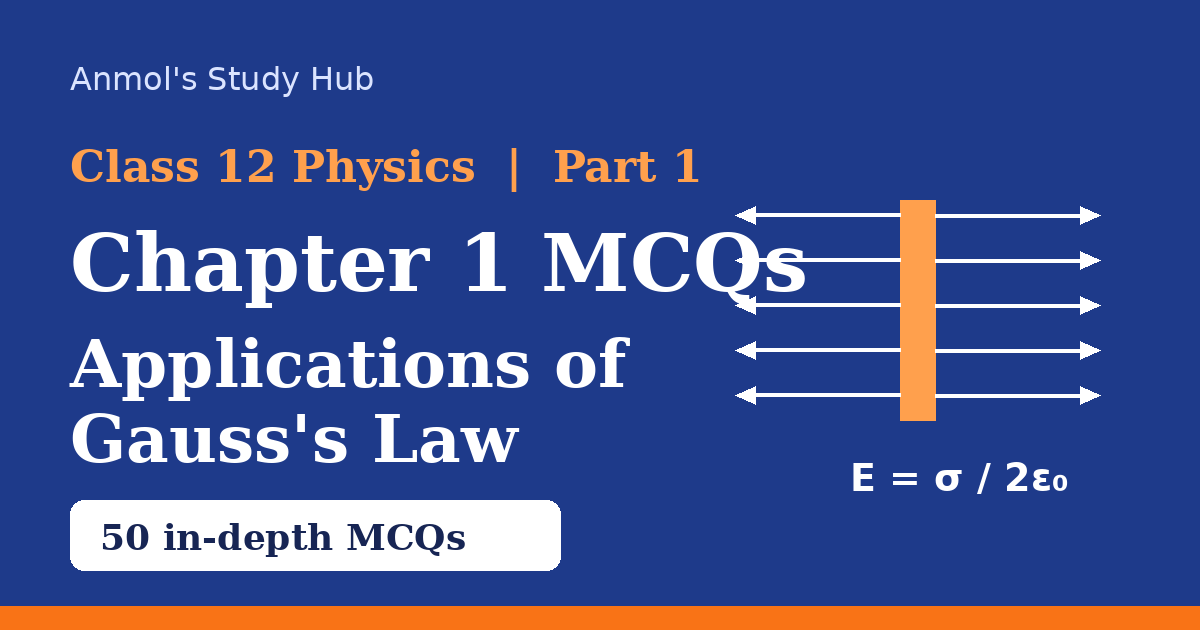
Class 12 Physics Part 1, Chapter 1 MCQs: Applications of Gauss’s Law
Electric Charges and Fields, Topic 6 of 6 · 50 in-depth MCQs · Name-based score card
Topic in one minute
This topic uses Gauss’s law to find the electric field of symmetric charge distributions: an infinite line of charge, an infinite plane sheet, and a thin spherical shell. It also shows how two parallel sheets give a uniform field between them. The skill to learn is choosing the right Gaussian surface.
Results at a glance
| Charge distribution | Field | Depends on distance as | Gaussian surface |
|---|---|---|---|
| Infinite line charge | λ/(2πε0r) | 1/r | Coaxial cylinder |
| Infinite plane sheet | σ/(2ε0) | Independent of r | Cylinder through the sheet |
| Thin shell, outside | q/(4πε0r²) | 1/r² | Concentric sphere |
| Thin shell, inside | 0 | None | Concentric sphere |
| Two opposite sheets, between | σ/ε0 | Independent of r | Superposition |
How to apply Gauss’s law
- Identify the symmetry of the charge distribution (cylindrical, planar, or spherical).
- Choose a Gaussian surface on which E is constant and either parallel or perpendicular to the surface.
- Find the enclosed charge q inside the surface.
- Write the flux as E times the area, and equate it to q/ε0.
- Solve for E and state its direction.
Question levels
| Level | What it covers | MCQs |
|---|---|---|
| Concept questions | Fields of a line, a sheet and a shell, Gaussian surfaces, symmetry, graphs of E against r | 20 |
| Numerical problems | Fields at given distances, ratios, force on a charge, charge densities, flux through a cylinder | 18 |
| Application and reasoning | Shell cavity, infinite-sheet approximation, parallel plates, choice of Gaussian surface, point charge versus shell | 12 |
Practise the MCQs
Choose a mode and start answering. No sign-up is needed. Your name is optional and is asked only when you press Show my score card.
1. The field of an infinite line charge of density λ at distance r is:
Show answer and explanation
Answer: B. λ/(2πε₀r). Gauss’s law with a coaxial cylinder gives E = λ/(2πε₀r).
2. The field of an infinite line charge is directed:
Show answer and explanation
Answer: B. Radially, perpendicular to the line. By cylindrical symmetry, E points radially outward from a positive line.
3. The field of an infinite line charge varies with distance as:
Show answer and explanation
Answer: B. 1/r. E is proportional to 1/r.
4. The suitable Gaussian surface for an infinite line charge is a:
Show answer and explanation
Answer: A. Coaxial cylinder. A coaxial cylinder matches the cylindrical symmetry.
5. The SI unit of linear charge density λ is:
Show answer and explanation
Answer: C. C/m. Charge per unit length.
6. The field of an infinite plane sheet of surface charge density σ is:
Show answer and explanation
Answer: B. σ/(2ε₀). Applying Gauss’s law with a cylinder through the sheet gives E = σ/(2ε₀).
7. The field of an infinite plane sheet:
Show answer and explanation
Answer: C. Is independent of distance. E = σ/(2ε₀), with no r in it.
8. The field of a positively charged infinite sheet is directed:
Show answer and explanation
Answer: B. Perpendicular to the sheet and away from it. By planar symmetry, the field is normal to the sheet, pointing away for a positive charge.
9. The suitable Gaussian surface for an infinite plane sheet is a:
Show answer and explanation
Answer: B. Cylinder (pillbox) that cuts through the sheet. The flux passes only through the two flat ends.
10. Outside a uniformly charged thin spherical shell, the field is the same as if all the charge were:
Show answer and explanation
Answer: B. At the centre. E = kq/r² for r > R.
11. Inside a uniformly charged thin spherical shell, the field is:
Show answer and explanation
Answer: B. Zero. A concentric Gaussian sphere inside encloses no charge.
12. The graph of E against r for a thin charged shell shows:
Show answer and explanation
Answer: B. Zero inside and a 1/r² fall outside. E = 0 for r < R, and E = kq/r² for r > R.
13. The suitable Gaussian surface for a thin spherical shell is a:
Show answer and explanation
Answer: A. Concentric sphere. A concentric sphere matches the spherical symmetry.
14. Which charge distribution gives a uniform field on each side?
Show answer and explanation
Answer: B. Infinite plane sheet. Its field is independent of distance.
15. The field lines of an infinite charged sheet are:
Show answer and explanation
Answer: B. Parallel to each other and perpendicular to the sheet. They are straight, parallel, and equally spaced.
16. Between two parallel sheets with equal and opposite charge densities, the field is:
Show answer and explanation
Answer: C. σ/ε₀. The two fields σ/(2ε₀) add between the sheets.
17. Between two parallel sheets with equal like charges, the field is:
Show answer and explanation
Answer: B. Zero. The fields point in opposite directions and cancel.
18. We assume a line or a sheet to be infinite so that we can:
Show answer and explanation
Answer: A. Ignore edge effects. Infinite size gives perfect symmetry and removes edge effects.
19. An infinite line charge has which kind of symmetry?
Show answer and explanation
Answer: B. Cylindrical. The field depends only on the distance from the line.
20. A uniformly charged shell has which kind of symmetry?
Show answer and explanation
Answer: A. Spherical. The field depends only on the distance from the centre.
21. A line charge of 2 × 10⁻⁶ C/m produces a field at 0.2 m of about:
Show answer and explanation
Answer: A. 1.8 × 10⁵ N/C. E = 2kλ/r = 2 × 9×10⁹ × 2×10⁻⁶ / 0.2 = 1.8 × 10⁵ N/C.
22. The field of a line charge is 400 N/C at a distance r. At 2r, it is:
Show answer and explanation
Answer: A. 200 N/C. E is proportional to 1/r, so doubling r halves E.
23. The field of a line charge is 90 N/C at a distance r. At 3r, it is:
Show answer and explanation
Answer: B. 30 N/C. Tripling r divides E by 3.
24. A sheet with σ = 8.85 × 10⁻⁶ C/m² produces a field of:
Show answer and explanation
Answer: A. 5 × 10⁵ N/C. E = σ/(2ε₀) = 8.85×10⁻⁶ / (2 × 8.85×10⁻¹²) = 5 × 10⁵ N/C.
25. For an infinite sheet, the ratio of the field at 1 m to the field at 5 m is:
Show answer and explanation
Answer: C. 1 : 1. The field is independent of distance.
26. A sheet with σ = 2 µC/m² produces a field of about:
Show answer and explanation
Answer: A. 1.1 × 10⁵ N/C. E = σ/(2ε₀) = 2×10⁻⁶ / (1.77×10⁻¹¹) ≈ 1.1 × 10⁵ N/C.
27. A thin shell with a charge of 2 µC has a field at 0.6 m from the centre (shell radius 0.2 m) of:
Show answer and explanation
Answer: A. 5 × 10⁴ N/C. E = 9×10⁹ × 2×10⁻⁶ / (0.6)² = 5 × 10⁴ N/C.
28. The field at 0.1 m from the centre of a charged shell of radius 0.2 m is:
Show answer and explanation
Answer: A. Zero. The point is inside the shell, where the field is zero.
29. For a shell of radius R, the ratio of the field just outside at 2R to that at R is:
Show answer and explanation
Answer: B. 1/4. E is proportional to 1/r², so doubling r gives 1/4.
30. For a shell of radius R, the ratio of the field at 3R to that at R is:
Show answer and explanation
Answer: C. 1/9. E is proportional to 1/r², so tripling r gives 1/9.
31. Two parallel sheets carry ±8.85 × 10⁻⁶ C/m². The field between them is:
Show answer and explanation
Answer: A. 10⁶ N/C. E = σ/ε₀ = 8.85×10⁻⁶ / 8.85×10⁻¹² = 10⁶ N/C.
32. For the same two sheets, the field outside them is:
Show answer and explanation
Answer: C. Zero. Outside, the two fields are equal and opposite.
33. A line charge of 3 µC/m is 10 m long. The total charge is:
Show answer and explanation
Answer: B. 30 µC. q = λl = 3 × 10 = 30 µC.
34. A sphere of radius 1 m carries a total charge of 4π µC spread over its surface. The surface charge density is:
Show answer and explanation
Answer: A. 1 µC/m². σ = q/(4πR²) = 4π / 4π = 1 µC/m².
35. A shell of radius 0.1 m has a charge of 2 µC. The field just outside is about:
Show answer and explanation
Answer: A. 1.8 × 10⁶ N/C. E = 9×10⁹ × 2×10⁻⁶ / (0.1)² = 1.8 × 10⁶ N/C.
36. A 1 µC charge is placed in a field of 1.8 × 10⁵ N/C. The force on it is:
Show answer and explanation
Answer: A. 0.18 N. F = qE = 10⁻⁶ × 1.8×10⁵ = 0.18 N.
37. A 2 µC charge is in the field of an infinite sheet of 10⁵ N/C. The force is:
Show answer and explanation
Answer: B. 0.2 N. F = qE = 2×10⁻⁶ × 10⁵ = 0.2 N.
38. A coaxial cylinder of length 2 m encloses a line charge of 4 µC/m. The net flux through it is about:
Show answer and explanation
Answer: A. 9 × 10⁵ N m²/C. q = 8 µC, so Φ = 8×10⁻⁶ / 8.85×10⁻¹² ≈ 9 × 10⁵ N m²/C.
39. The field lines of a charged infinite sheet are:
Show answer and explanation
Answer: A. Parallel and uniform on each side. The field has the same magnitude and direction on each side.
40. The field inside a uniformly charged thin shell is zero because:
Show answer and explanation
Answer: B. A concentric Gaussian sphere inside encloses no charge. Zero enclosed charge gives zero flux, and symmetry then gives E = 0.
41. A charged particle inside a uniformly charged thin shell feels:
Show answer and explanation
Answer: B. No force from the shell. The field due to the shell is zero inside.
42. Compared with a point charge, the field of a line charge falls with distance:
Show answer and explanation
Answer: B. More slowly. 1/r falls more slowly than 1/r².
43. A charge near an infinite sheet is moved further away. The force on it:
Show answer and explanation
Answer: C. Stays the same. The field of an infinite sheet is independent of distance.
44. A large finite sheet behaves like an infinite sheet at points that are:
Show answer and explanation
Answer: B. Close to it and far from the edges. Edge effects are small when the distance is much smaller than the size.
45. The uniform field between two parallel oppositely charged plates is used in a:
Show answer and explanation
Answer: A. Parallel plate capacitor. The same arrangement forms a capacitor.
46. The field lines of a positively charged sheet:
Show answer and explanation
Answer: B. Leave the sheet on both sides. They leave perpendicular to the sheet on both sides.
47. A cube is a poor Gaussian surface for a spherical shell because:
Show answer and explanation
Answer: B. E is not constant and perpendicular over its faces. The sphere’s symmetry gives constant radial E only on a concentric sphere.
48. The graph of E against r for an infinite line charge is:
Show answer and explanation
Answer: B. A curve falling as 1/r. E is inversely proportional to r.
49. The charge on a thin shell is doubled. The field outside at the same distance:
Show answer and explanation
Answer: B. Doubles. E is proportional to q.
50. A point charge q and a thin shell of the same total charge q give the same field:
Show answer and explanation
Answer: B. Outside the shell. For r > R, the shell acts like a point charge at its centre.
Common mistakes in this topic
- Using the sheet formula σ/(2ε0) for a conductor surface. For a conducting surface, the field is σ/ε0.
- Writing the line-charge field as 1/r². It falls only as 1/r.
- Forgetting that the field inside a thin shell is zero.
- Choosing a Gaussian surface that does not match the symmetry, such as a cube around a point charge.
Quick FAQ
How should I use these MCQs? Start with Practice mode to learn from each explanation, then switch to Test mode and attempt all 50 questions without help.
What is “Retry my mistakes”? After your score card, it shows only the questions you got wrong or skipped, so you can practise them again.